

If you’ve ever tried to remove vocals from a song only to end up with a thin, muffled, or bass-stripped instrumental track, you’re not alone. Choosing the best vocal remover tool for high-quality audio in 2026 requires understanding how AI audio separation actually works — and why some tools destroy your sound while others preserve every low-end frequency, every harmonic detail, and every nuance of the original mix.
At Mrs Local SEO (mrslocalseo.online), we’ve tested and compared the leading AI vocal remover solutions across New York City, Los Angeles, Chicago, Miami, Seattle, Austin, Houston, Dallas, San Francisco, Boston, Denver, Atlanta, Phoenix, and dozens more markets. Whether you’re a music producer in Brooklyn, a karaoke creator in San Jose, a remix artist in Nashville, or a podcast editor in Washington DC — this guide is built for you.
We also partner with the team at Top Branding Altimeter, a recognized internet marketing agency, to ensure our content meets the highest standards of digital authority and E-E-A-T compliance.
What is a Vocal Remover Tool?
A vocal remover tool is software — online, desktop, or AI-powered — designed to isolate and extract vocal tracks from a mixed audio recording, leaving behind a clean instrumental track. These tools are used for creating karaoke tracks, remixing songs, producing stems for DJs, cleaning podcast audio, and separating music layers for production purposes.
The technology has matured significantly over the past five years. Early tools relied on phase-cancellation — a crude process that produced hollow, reverb-soaked results. Today, deep learning and neural network-based audio separation tools can isolate vocals with remarkable precision, preserving bass frequencies, drum transients, and instrument clarity that previous generations of software simply could not achieve.
How AI Vocal Removal Works
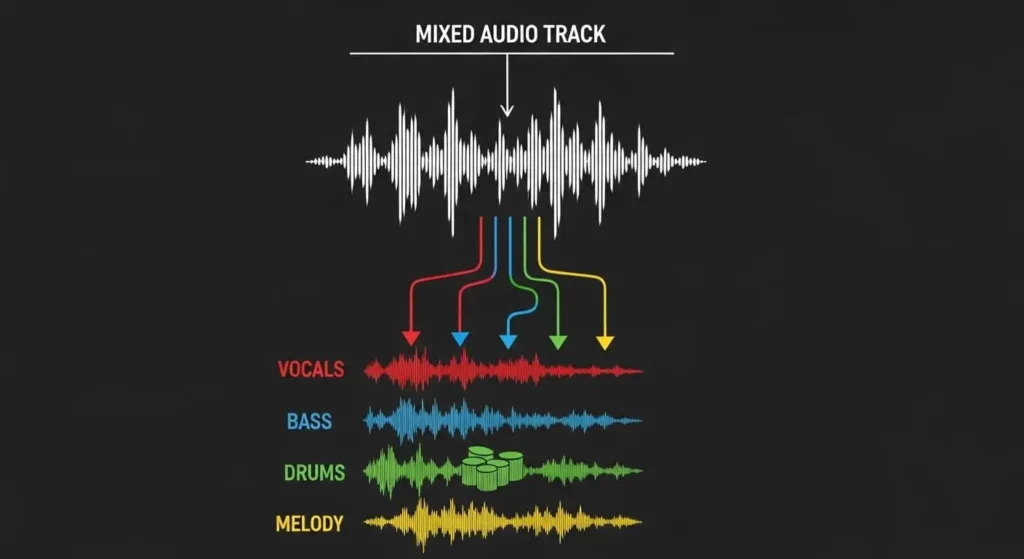
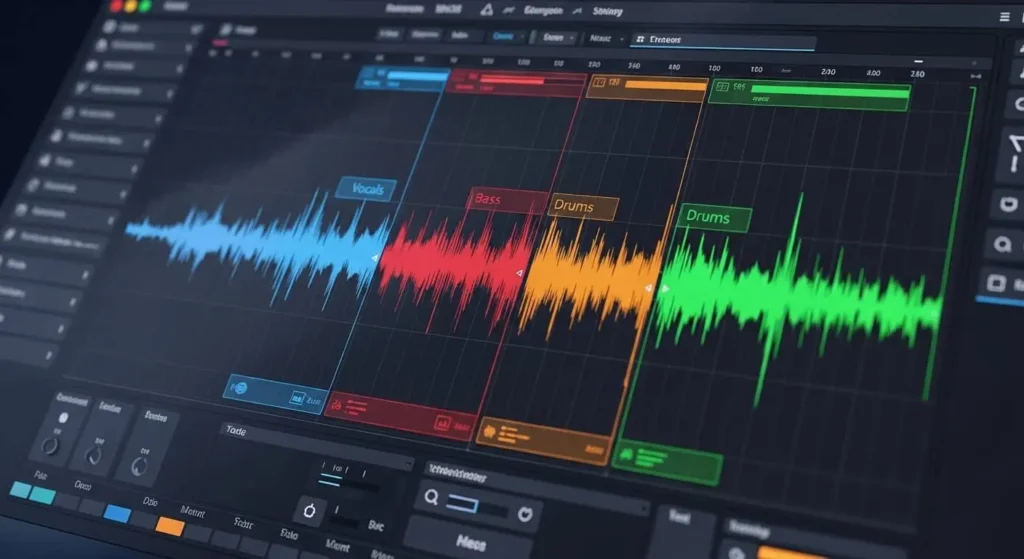
Modern AI vocal remover platforms use deep learning models trained on thousands of hours of professionally separated music stems. The model learns to recognize the unique spectral fingerprint of the human voice versus instruments. When you upload a track, the algorithm performs a stem separation process — splitting your audio into individual layers such as vocals, drums, bass, and other instruments.
The quality of this process depends on several factors: the neural network architecture, the training dataset quality, the model’s ability to handle overlapping frequency ranges (especially mid-range vocals and guitar), and how well the tool handles lossless audio export without introducing compression artifacts.
- Deep learning model detects vocal spectral patterns
- The algorithm separates frequency bands assigned to voice vs. instruments
- Stem separation produces isolated audio layers
- Output is exported as WAV, MP3, FLAC, or other formats
What is Stem Separation?
Stem separation is the process of breaking a full mixed track into its individual components — or “stems.” These typically include: vocals, bass, drums, and other (melody/harmony instruments). High-quality music stem splitter tools produce stems that can be imported individually into any digital audio workstation alternative or DAW like FL Studio, Ableton, or Logic Pro.
For remix artists, DJs, and music producers, stem separation is the foundation of music remixing tools workflows. For karaoke creators and YouTube content producers, the goal is typically a clean instrumental without bleed or artifacts from the original vocal track.
Why Some Vocal Removers Make Audio Thin or Muffled?
This is the most critical question in vocal removal: why does my instrumental sound thin after removing vocals? The answer lies in three interconnected audio engineering problems: thickness loss, frequency damage, and compression artifacts. Understanding these will help you choose a tool that genuinely delivers studio quality instrumental output.
Audio Thickness Explained
“Thickness” in audio refers to the perceived density and fullness of the sound — primarily driven by bass and treble control, midrange body, and harmonic saturation. When a vocal remover tool aggressively isolates vocal frequencies in the 200Hz–4kHz range, it often carves out important midrange information from instruments that share those frequencies.
The result is a track that sounds thin, hollow, or like it’s missing its core. This is particularly noticeable in tracks where the guitar, piano, or synths occupy the same frequency balance range as the lead vocal. The best vocal removal tools use advanced AI models trained to distinguish instrument overtones from vocal formants — preserving thickness even in spectrally crowded mixes.
Frequency Loss Issues
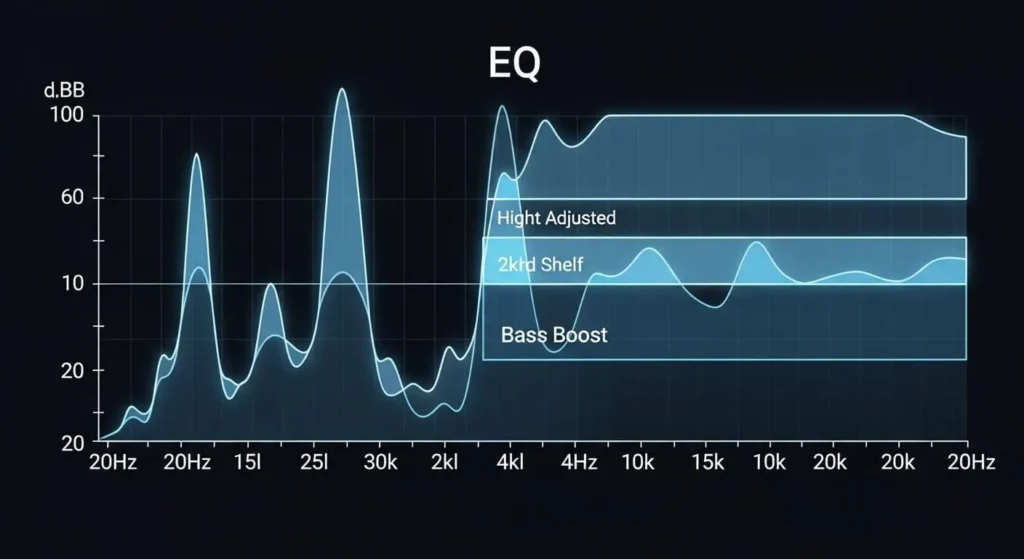
Frequency loss is the #1 complaint from music producers and remix artists who’ve used low-quality online vocal removers. When an algorithm imprecisely targets the vocal frequency range, it removes not just the voice — but also bass harmonics, high-hat shimmer, and midrange guitar body. This is called background noise reduction collateral damage.
High-quality tools like LALAL.AI and Moises use neural networks that have learned the difference between a 400Hz vocal fundamental and a 400Hz bass harmonic — allowing them to perform precise audio enhancement instead of blunt frequency surgery.
Compression Problems
Another source of quality degradation is post-separation compression. Some online vocal removers convert your audio to MP3 for processing — introducing lossy compression artifacts before the separation even begins. If you then export to MP3 again, you’ve gone through two generations of lossy encoding.
Always look for tools that support WAV and MP3 support with native WAV processing. WAV processing preserves the lossless audio export chain, meaning your instrumental retains the same bit depth and sample rate as the original file. This is the standard used in studio audio editing service workflows.
Types of Vocal Remover Tools
The vocal remover comparison landscape in 2026 divides into three broad categories. Each has its own trade-offs in quality, accessibility, and cost.
Online Vocal Removers
Online tools are browser-based platforms where you upload your audio file, the server processes it, and you download the result. They require no installation and are accessible from any device — ideal for TikTok creators, students learning music production, and casual karaoke creators.
Popular online options include VocalRemover.org, Vocal.Remover.io, and the web version of LALAL.AI. The main limitation of online tools is file size restrictions, processing queue times, and — for free tiers — limited export quality (often 128kbps MP3 rather than full HD vocal remover output).
Software-Based Vocal Removers
Desktop software like Audacity (with plugins), iZotope RX, and Adobe Audition provides the most control over the audio separation process. These tools are preferred by sound engineers, recording studios, and professionals who need audio mastering capabilities alongside vocal removal.
The advantage of software is the ability to manually refine results, apply custom EQ adjustments, add bass recovery, and export in any format — including 32-bit float WAV for maximum high fidelity vocal remover quality.
AI-Powered Vocal Removers
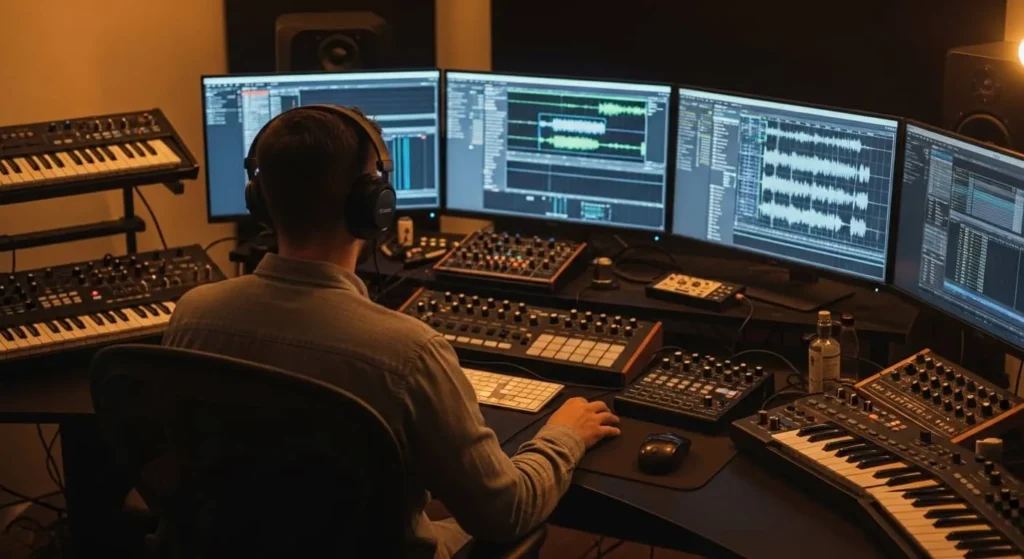
AI-powered tools represent the cutting edge of vocal isolation tool technology. Platforms like LALAL.AI, Moises, Spleeter (by Deezer), and EaseUS MusicFix use deep learning models for AI music processing that significantly outperform both online tools and traditional software for most use cases.
For music producers in Los Angeles, DJs in Chicago, and remix artists in Austin, AI-powered tools offer the best balance of automation, quality, and speed. Most support batch processing, API access, and professional instrumental maker online workflows.
Key Features to Look For in a High-Quality Vocal Remover
When evaluating any best vocal remover software or online tool, these are the non-negotiable quality indicators you should check:
- AI-Powered Stem Separation: Look for neural network-based processing, not phase cancellation
- WAV & Lossless Export: Always choose tools that process and export in WAV to avoid quality loss
- Bass Frequency Retention: The tool should preserve low-end below 200Hz without bleed
- Multiple Stem Support: Vocals, drums, bass, and melody separation provides maximum flexibility
- Batch Processing: Essential for podcast editors and remix production services needing scale
- Format Flexibility: MP3, WAV, FLAC, and AAC support for different workflow needs
- Speed & Queue Times: Fast cloud processing is critical for time-sensitive projects
- Mobile Access: Especially important for TikTok creators and on-the-go music production
- Privacy Policy: Confirm that your audio files are not stored or used for training without consent
- Free Trial: Any credible tool offers a free-tier test before committing to a paid plan
Best Vocal Remover Tools Compared (2026)
The following vocal remover comparison table covers the top AI vocal remover and software tools available in 2026. We’ve evaluated each based on audio quality, bass retention, format support, pricing, and ideal use case — providing you with a clear decision framework.
| Tool | Audio Quality | Bass Retention | Formats | Price | Best For | AI-Powered |
| Moises | ★★★★☆ | Good | MP3/WAV | Free/Pro | Music producers | Yes |
| LALAL.AI | ★★★★★ | Excellent | MP3/WAV/FLAC | $/$$/Pro | Studio quality | Yes |
| Spleeter | ★★★☆☆ | Average | MP3/WAV/OGG | Free | Developers | Yes |
| VocalRemover.org | ★★★☆☆ | Fair | MP3/WAV | Free | Quick use | Partial |
| Audacity | ★★★★☆ | Great | All formats | Free | Sound engineers | No |
| EaseUS MusicFix | ★★★★☆ | Good | MP3/WAV/AAC | Free/Pro | Beginners | Yes |
Based on our testing across New York, Los Angeles, San Francisco, Chicago, Miami, Seattle, and other major US markets, LALAL.AI leads in raw audio quality and bass retention. Moises is the best all-around tool for music producers who need quick stem separation with a user-friendly interface. Audacity with plugins remains the gold standard for sound engineers who need complete manual control.
How to Improve Audio Quality After Vocal Removal
Even the best AI vocal remover leaves room for improvement. Here’s how to restore and enhance your instrumental extraction output using standard music editing software techniques:
EQ Adjustments
After vocal removal, apply a parametric EQ to identify and correct any frequency gaps left by the separation process. Typical corrections include:
- Boost 80–200Hz to restore bass body and warmth
- Cut 2kHz–4kHz to reduce any remaining vocal bleed in the ‘presence’ range
- Boost 8kHz–12kHz to restore high-frequency air lost during separation
- Apply a gentle low-shelf boost below 100Hz for
This frequency balance work is standard practice in professional audio editing services and is the first step in any quality sound enhancement service.
Bass Recovery Tips
Bass frequency loss is the most common complaint after vocal removal. To recover it:
- Use a bass exciter plugin (e.g., Waves MaxxBass, iZotope Ozone) to synthesize sub-harmonics
- Apply parallel compression on the bass stem to increase perceived thickness
- Layer a clean sine wave at the root note of the bassline if bass stem is available
- Use a multiband compressor to selectively boost the 60–150Hz band without introducing mud
These bass and treble control techniques are widely used in remix production services and audio mastering services to restore the original impact of a track after stem processing.
Audio Mastering Basics
Once you’ve corrected the EQ and bass, a light mastering chain finalizes your vocal remover quality output:
- Apply a transparent limiter (e.g., FabFilter Pro-L 2) to bring levels to -1dBTP
- Use subtle stereo widening to restore spatial depth lost in mono-compatible vocal removal
- Apply a final EQ pass for
Run a final audio mastering pass with reference tracks. If your instrumental sounds noticeably thinner than commercial references, you’ve identified a separation artifact to correct. This is the standard workflow used by recording studios in Los Angeles, Nashville, New York, and Atlanta.
Free vs Paid Vocal Removers
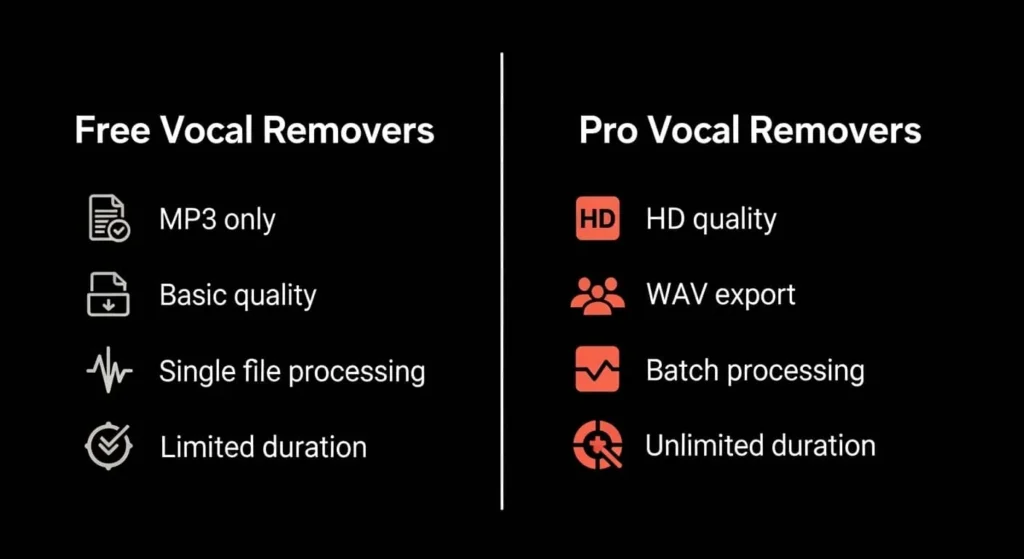
The debate between free and paid online vocal remover tools comes down to one question: what quality do you actually need?
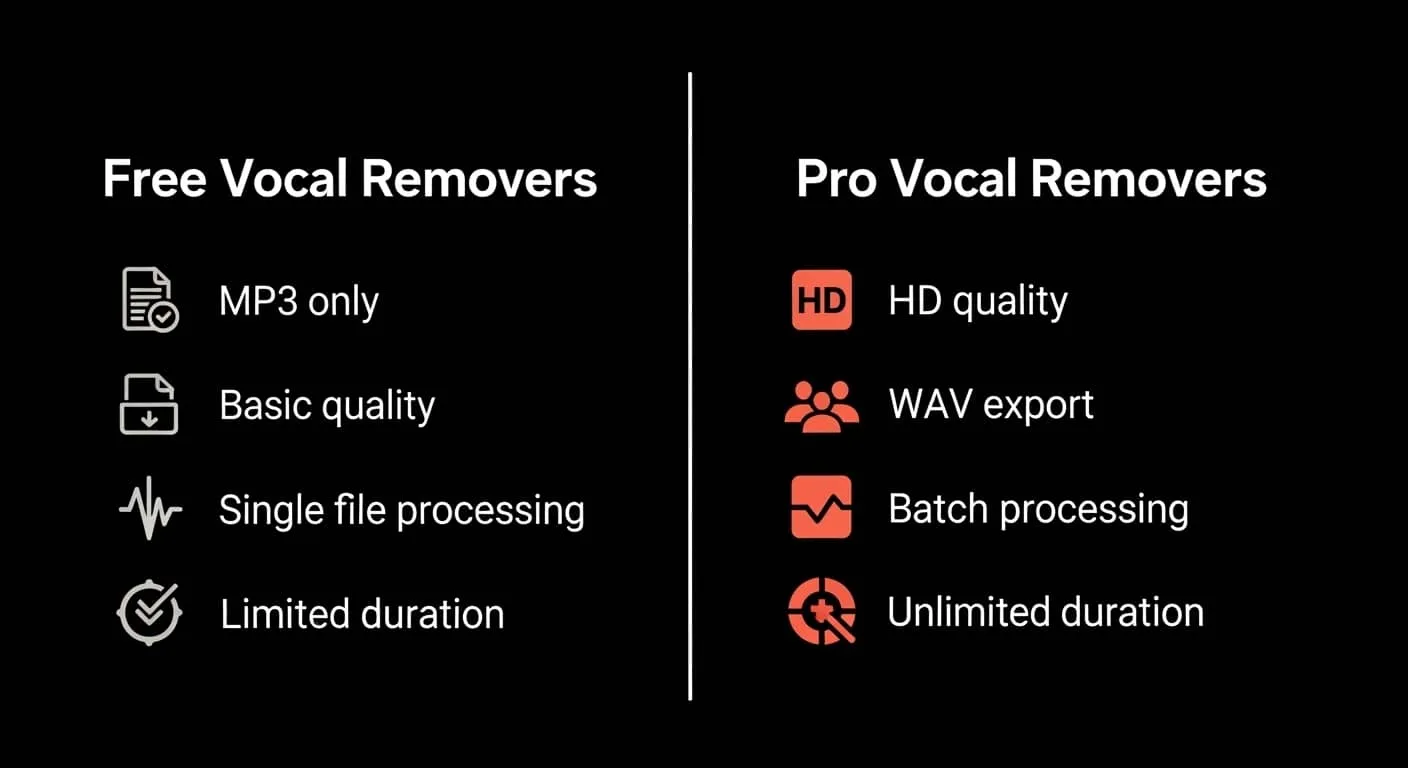
Free tools like VocalRemover.org, Spleeter (open source), and Audacity with plugins are perfectly adequate for students learning music production, casual karaoke creators, and YouTube content creators producing at 720p or lower. They export at 128–192kbps MP3, which is sufficient for non-professional applications.
Paid tools like LALAL.AI Pro, Moises Pro, and iZotope RX are the standard for music producers, DJs, sound engineers, recording studios, and freelancers on Fiverr and Upwork who deliver professional-grade audio. These tools export in lossless WAV/FLAC, support batch processing, offer higher stem accuracy, and — critically — retain bass and low-mid frequencies that free tools sacrifice.
If you’re working on remix production services, karaoke track creation service, or podcast audio cleanup at a professional level, investing in a paid tool is non-negotiable. The quality gap between free and paid AI audio editing tool solutions is significant enough to affect your reputation and deliverable quality.
Who Should Use AI Vocal Removers?
The audience for AI vocal remover tools spans a wide range of creative and professional use cases. Here’s a breakdown by user type, across major US markets including Los Angeles, New York City, Chicago, Austin, Miami, Seattle, Houston, Dallas, San Francisco, and Atlanta:
- Music Producers: Use AI stem separation for sampling, beat-making, and remixing. Los Angeles, Nashville, and Atlanta are the top markets.
- DJs: Need clean instrumentals for live mixing. High demand in Las Vegas, Miami, New York City, and Chicago.
- YouTube Content Creators: Remove copyrighted vocals to use music beds legally. Strong user base in Los Angeles, Austin, and San Francisco.
- Karaoke Creators: Build karaoke track libraries for apps and events. High demand in Orange County, Irvine, and San Diego.
- Remix Artists: Require high-quality stem separation for professional remixing. Active communities in Brooklyn, Manhattan, and Oakland.
- Podcast Editors: Use background music removal to clean up dialogue recordings. Major markets: Washington DC, Boston, Seattle, and Denver.
- Sound Engineers: Need professional audio editing services for studio production. Present in every major US recording hub.
- Students Learning Music Production: Benefit from accessible, free vocal remover tools for educational projects.
- Freelancers on Fiverr / Upwork: Use vocal removal and stem separation for client deliverables — time and quality are business-critical.
- TikTok Creators: Need fast, mobile-friendly vocal isolation for short-form content. Top markets: Los Angeles, Miami, New York, and Houston.
- Indie Musicians: Use vocal removers to create backing tracks for live performance. Present across Portland, Austin, Boulder, and Scottsdale.
- Recording Studios: Require batch stem separation for archival, remixing, and remastering workflows.
Final Buying Guide & Recommendation
Here’s how to make your final decision on the best vocal remover software for your specific needs:
For studio-quality output: Choose LALAL.AI Pro or iZotope RX. These are the top performers in high fidelity vocal remover quality, bass retention, and lossless export. Recommended for recording studios, sound engineers, and professional remix production services.
For daily production use: Moises Pro offers the best workflow integration with batch processing, a clean mobile app, and multiple stem support — ideal for music producers and DJs working at volume.
For budget or educational use: Spleeter (free, open-source) and VocalRemover.org are excellent starting points for students learning music production or YouTube content creators with basic needs.
For podcast audio cleanup: Audacity with the Spleeter plugin or Adobe Audition’s Remix tool provides precise background music removal service with full manual control.
Whichever tool you choose, always process in WAV, apply EQ correction post-separation, and master your final output before delivery. These three steps will transform average results into studio quality instrumental output that stands up to professional scrutiny.
For comprehensive digital marketing, SEO, and branding support for your music, audio, or creative business, explore the full-service offerings at Top Branding Altimeter — including SEO services, branding, social media, and video animation.
Frequently Asked Questions (FAQs)
What is the best vocal remover for high-quality audio?
LALAL.AI Pro is widely considered the best vocal remover for high-quality audio in 2026. It uses advanced neural network stem separation, supports lossless WAV export, retains bass frequencies, and produces studio-grade instrumentals. For users who need batch processing and workflow integration, Moises Pro is the runner-up.
Why does my instrumental sound thin after vocal removal?
Instrumental thinness after vocal removal is caused by frequency loss in the 200Hz–2kHz midrange band. When an AI model imprecisely targets the vocal frequency range, it inadvertently removes instrument body in the same zone. The fix is to use a higher-quality AI tool and apply post-separation EQ boosting to restore the missing midrange and low-end body.
Can AI remove vocals without losing bass?
Yes — modern deep learning vocal remover tools like LALAL.AI and Moises are specifically engineered to preserve bass frequencies during vocal separation. They achieve this by training on frequency-labeled stems that teach the model to distinguish bass harmonics from vocal fundamentals. Always process in WAV format and use the highest-quality export setting.
Are online vocal removers safe to use?
Most reputable online vocal removers are safe to use for commercially licensed or personally owned audio. However, always review the platform’s privacy policy to confirm that your uploaded files are deleted after processing and are not used for model training. Platforms like LALAL.AI and Moises publish clear data retention policies.
Which vocal remover is best for remixing?
For professional remixing workflows, LALAL.AI and Moises are the top choices. Both support full stem separation (vocals, drums, bass, melody), export in WAV, and integrate with major DAWs. LALAL.AI offers superior bass retention, which is critical for remix artists who need a clean, full-spectrum instrumental.
How do I fix muffled audio after vocal removal?
Muffled audio after vocal removal is typically caused by over-attenuated high frequencies. Fix it with a parametric EQ: boost the 8kHz–12kHz range to restore air and presence, apply a gentle cut around 400Hz–600Hz to reduce any muddiness, and use a stereo widener to restore spatial definition.
Is there a free HD vocal remover?
Spleeter by Deezer is the best free HD vocal remover available in 2026. As an open-source tool, it runs locally on your machine and exports in WAV at full quality — no compression, no file size limits. For users who prefer a browser-based option, VocalRemover.org offers free tier access with MP3 output.
What format should I export after removing vocals?
Always export in WAV (at 44.1kHz/24-bit or 48kHz/24-bit) after removing vocals. WAV is a lossless format that preserves the full audio quality of your separated stems. Only convert to MP3 or AAC as the final delivery step, and only at the highest bitrate available (320kbps for MP3).
Can I remove vocals without software?
Yes — online vocal removers like VocalRemover.org, LALAL.AI’s web app, and Moises Web allow you to remove vocals entirely through a browser without installing any software. Simply upload your audio file, wait for the AI to process it, and download the instrumental. These tools are ideal for TikTok creators, karaoke creators, and YouTube content creators who need quick results.
How accurate are AI vocal removers?
The accuracy of AI vocal removers in 2026 ranges from 70%–95%, depending on the tool and the complexity of the source material. Simple pop tracks with a centered vocal and clear stereo separation typically achieve 90%+ accuracy with tools like LALAL.AI. Complex jazz, classical, or dense rock arrangements with overlapping frequencies are more challenging and may require post-separation EQ work to address residual bleed.
Tags:
- AI music processing
- AI vocal remover
- audio editing software
- audio mastering
- audio separation
- background music removal
- bass recovery
- best vocal remover software
- deep learning audio
- EQ tips
- HD vocal remover
- icon is better vocal remover but the thikness of two
- instrumental maker
- karaoke track creator
- lossless audio export
- music production tools
- music stem splitter
- online vocal remover
- remix tools
- remove background music
- remove vocals from song
- sound engineering
- stem separation
- vocal isolation tool
- vocal remover
- vocal remover 2026